
What 51.8 °C actually does to a pilgrim's body
Core temperature climbs long before thirst or dizziness arrive. The physiology of heat strain in iḥrām, and why a warning twelve minutes early changes the outcome.
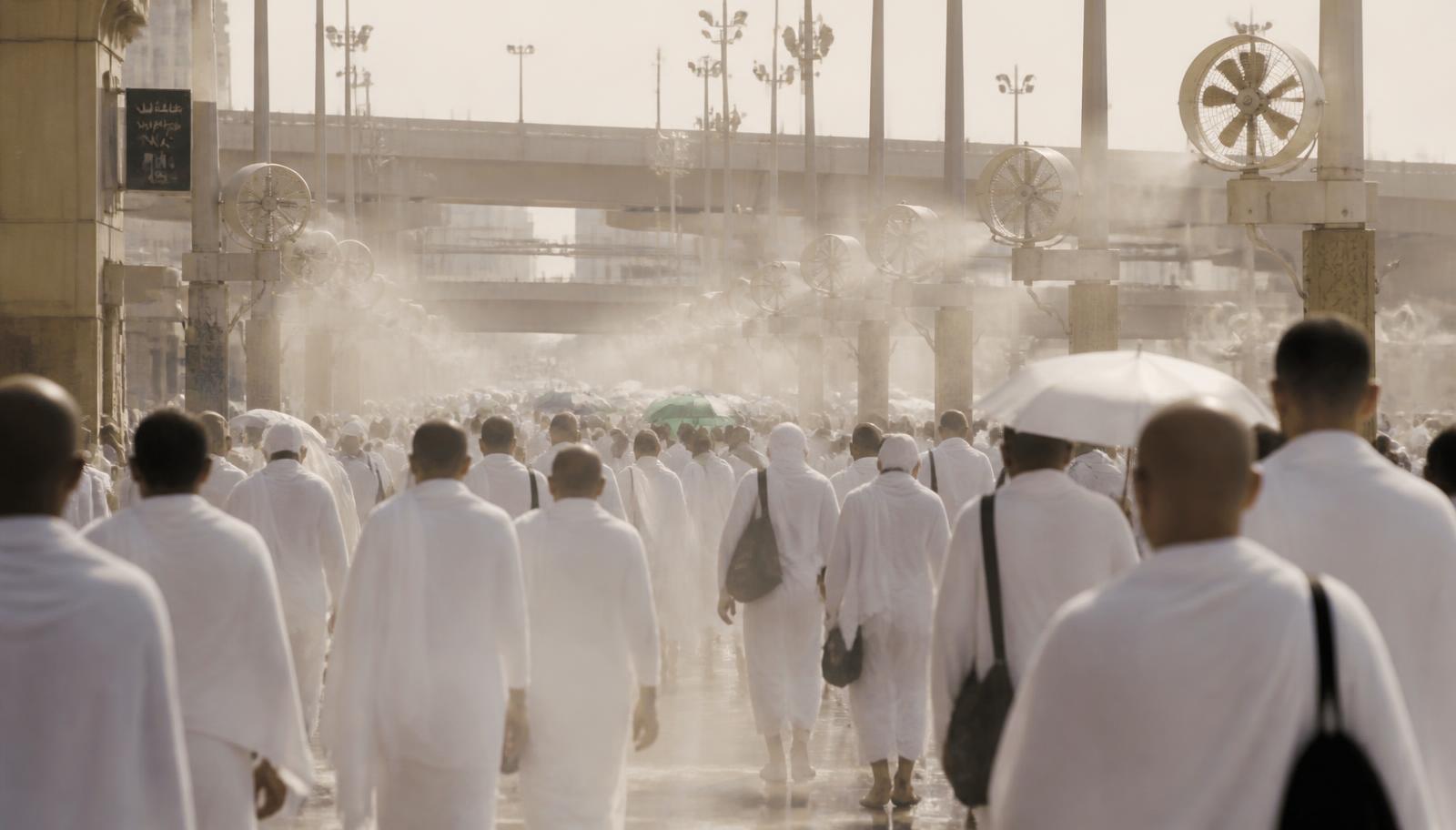
A pilgrim walking the open stretch between Minā and Jamarāt at midday is doing something the human thermoregulatory system was never designed for: sustained exertion, in unshaded radiant heat, while dehydrated, often while medicated for blood pressure or diabetes, and frequently after a night of little sleep.
The number that circulates each season — 51.8 °C recorded in the shade — is only the ambient reading. What matters clinically is the wet-bulb globe temperature, which folds in humidity, wind and radiant load. Above roughly 32 °C WBGT, evaporative cooling stops keeping pace with metabolic heat production during walking. From that moment the body is accumulating heat it cannot shed.
The silent hour before collapse
Heat illness is not a single event. It is a slope. Core temperature rises through 38.0, 38.5, 39.0 °C while the pilgrim still feels able to continue. Sweating increases, then — dangerously — decreases. Heart rate rises to defend cardiac output against falling plasma volume. Cognition narrows before it fails: pilgrims stop noticing thirst, stop noticing signage, and often stop noticing they have separated from their group.
By the time an observer sees confusion, staggering or hot dry skin, the person has been in physiological trouble for thirty to ninety minutes. The clinical window for cheap intervention — shade, water, an electrolyte sachet, ten minutes seated — closed long before.
Why wearables see it earlier
A ring worn on the finger cannot read core temperature directly, and any vendor claiming otherwise is selling something. What it can read continuously is skin temperature, heart rate, heart-rate variability, pulse amplitude and motion. Heat strain has a signature in those channels: a rising heart rate at a constant or falling pace, HRV collapse, and a skin-temperature trace that stops tracking exertion.
Labbayk AI is trained on those trajectories, not on thresholds. In field validation with operator groups the model flagged strain a median of twelve minutes before the pilgrim reported any symptom at all. Twelve minutes is not a dramatic number. It is simply the difference between drinking in the shade and being carried to a clinic.
“We do not need to predict who will die. We need to interrupt the ordinary afternoon in which someone quietly stops sweating.”
What a group leader should change tomorrow
- Move all non-essential walking outside 11:00–15:30 and treat that window as a scheduling constraint, not a preference.
- Assign hydration to a named person per twenty pilgrims; unassigned responsibility becomes nobody's.
- Pre-identify every pilgrim over 65 or on diuretics, beta blockers or insulin, and review them twice daily.
- Treat a single episode of confusion as an emergency, never as tiredness.
- Rehearse the escalation path before the season: who calls, who meets the ambulance, who holds the passport copy.
None of this is novel medicine. It is ordinary heat protocol, applied to a population that is older, more devout and more determined to continue than almost any other cohort of people moving on foot through a desert summer.
Last updated 20 July 2026